

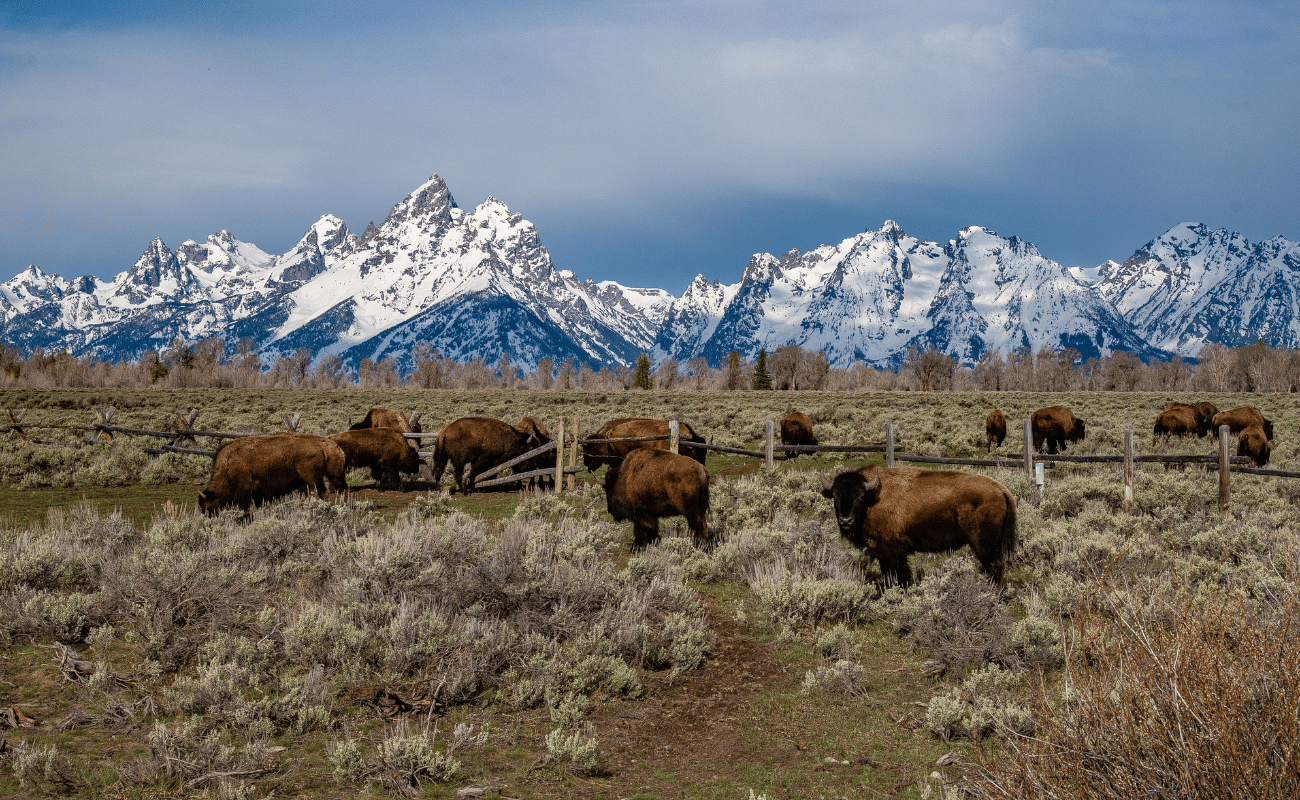
Bison look calm, and that is the problem. In Yellowstone, park officials say bison have injured more people than any other animal, and Grand Teton’s rangers warn that they hurt visitors who approach too closely every year. The grand teton bison herd, also called the Jackson bison herd, is the free ranging group of wild bison that grazes the sage flats of Jackson Hole in summer and, in most winters, gathers on the National Elk Refuge just north of town.
Bison are the largest land mammal in North America and the national mammal of the United States. An adult bull can top 2,000 pounds. This herd is smaller than the one in Yellowstone National Park, less famous, and easier to find. Its origin story is also stranger.
Built for a Wyoming winter
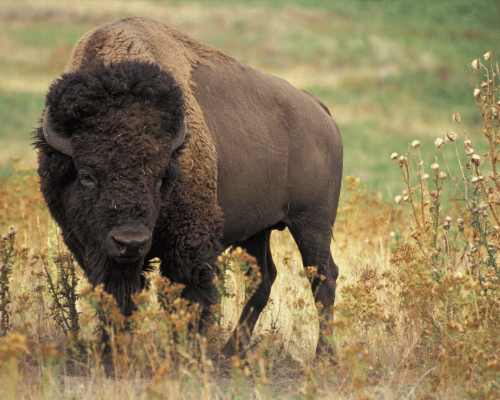
A bison’s shoulder hump is not a fat store. It is muscle, anchored to elongated spine bones, and its job is to drive the head like a plow.
That anatomy explains how they hold ground through winter while other grazers slide to lower country. Elk paw snow aside with their hooves, a habit covered in our Wyoming elk guide. Bison sweep it, swinging the head in wide arcs to reach grass nothing else reaches.
In deep snow, swept ground is easier to spot than the animals themselves. Find sage cleared in wide arcs, with fresh tracks and dung beside it, and the animals are usually close. The same pressures shape how animals here adapt to winter.
What the late summer rut does to the herd
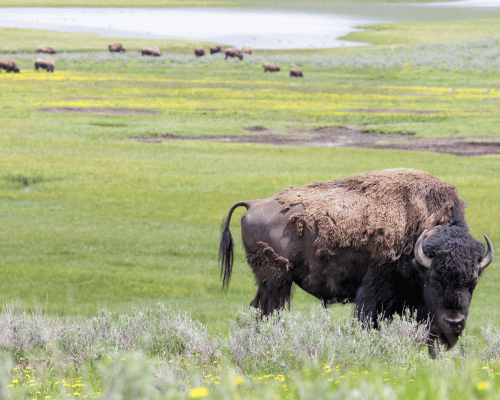
Most of the year, the group in front of you is cows, calves, and young animals. Bulls travel alone or in small bachelor bands and rejoin only in late summer or early fall, when the rut begins.
Then the herd changes shape. Bulls bellow, wallow hard enough to throw dust you can see from the road, and shove head to head to settle rank. Most of it is bluff. Real fights are short.
A paired bull tends one cow, shadowing her and cutting off rivals. Mark Bolen, founder and guide at Teton Wild, tells guests during the rut to watch the quiet bull beside a single cow rather than the two putting on a show.
Cows decide where the herd goes
Movement decisions belong to experienced cows, not the largest bull. The group follows her to water and forage, and the bulls follow. Useful, if you are guessing where the animals will be in an hour.
Calves and the red dog stage
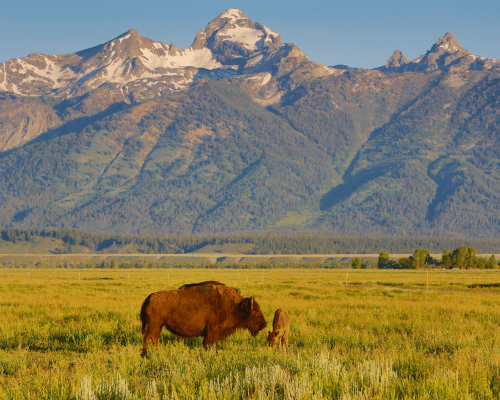
After a gestation period of approximately 9 months, the cow gives birth to a single calf. In the spring, typically from April to May, the calves arrive. Newborns are called red dogs for their reddish brown coats, and a calf weighs around 30-70 pounds (14-32 kilograms) at birth. They nurse, shift onto vegetation, and stay tight to their mothers until roughly one year of age.
Two windows call for caution: cows with new calves, and bulls in rut. Both turn an animal that normally ignores people into one that reacts.
The grand teton bison herd nearly vanished, then came back through a fence
Every free ranging bison in Jackson Hole today descends from animals that got out of an enclosure. This population was not restored on purpose. It restored itself.
Market hunting erased bison from the valley in the 1800s. In 1948, Laurance S. Rockefeller’s Jackson Hole Preserve, the New York Zoological Society, and the Wyoming Game and Fish Commission opened the Jackson Hole Wildlife Park, a fenced wildlife park near Moran, and stocked it with a small captive herd. The refuge’s management plan puts that founding group at 20 bison from Yellowstone. In 1968, park records say, 15 animals broke through the fences. Managers let them range free, they found the winter range unaided, and the Teton herd grew from those escapees.
The National Elk Refuge made that growth possible. The small herd began wintering there in 1975, and around 1980 the animals started eating the supplemental feed put out for elk. Feed removes the ceiling winter normally puts on a population, and the herd climbed past 1,000 animals.
How big is the grand teton bison herd today?
Smaller than its peak, by design. The 2007 Bison and Elk Management Plan, shared by the U.S. Fish and Wildlife Service and Grand Teton National Park, set an objective of about 500 animals, and a state licensed hunt outside the park keeps numbers near it. Counts swing from year to year because not every animal comes to the refuge in winter, so treat any single figure as a snapshot.
Feeding is also the root of the management fight. Brucellosis is a bacterial disease carried by bison and elk across the Greater Yellowstone Ecosystem that causes cattle to abort, and the transmission risk keeps the National Park Service, the Wyoming Game and Fish Department, and ranchers arguing over herd size. For the Lakota people and other Native American tribes, bison were food, hide, tool stock, and ceremony, and the near destruction of the herds was inseparable from the assault on those cultures.
Where the herd turns up, and how to watch it safely
Antelope Flats is the most reliable bison ground in Grand Teton National Park. That open sage grassland near Moose Junction gives the herd room to graze and gives you long sightlines.
Their movements cannot be scheduled. Ask a ranger or guide about recent sightings before committing a morning to one turnout, because the herd can be miles from where it stood yesterday.
Reading a bison before it charges
An animal almost always signals discomfort before it charges. The catch is that most people are already too close by then. The National Park Service requires visitors to stay at least 25 yards (23 meters) from bison and all other wildlife, and at least 100 yards from bears and wolves. If an animal reacts to you at all, you are too close, whatever the measured distance. Treat 25 yards as a floor, not a target.
Speed is what people misjudge. Bison can pass 30 miles per hour, no one outruns one over open ground, and they pivot more sharply than their bulk suggests. Never walk toward one, for a photograph or anything else. Watch for these signs, roughly in the order they show up:
Those are late warnings, not opening ones. Use binoculars or a telephoto lens, stay on designated roads and pullouts, and stay in the vehicle when animals are on the pavement, because roads are travel corridors for them too. If a herd is crossing, wait it out with the engine idling; honking or creeping forward can split cows from calves, and a separated cow is far more likely to react. A long lens does the approaching for you, and the wildlife photography tips for Grand Teton cover settings that work from a pullout.
Summer and fall put the herd on the park’s sage flats, while winter pulls most animals south toward the refuge, so check the best time to visit Grand Teton before planning around them. Start at Antelope Flats at first light, then work the Gros Ventre road and the Elk Ranch Flats turnout if it comes up empty. If you want moose and elk as well as the grand teton bison herd, a guided wildlife tour covers more ground than a self drive loop. For the wider cast of species, start with our guide to the top 10 animals in Grand Teton National Park.
Common questions about the Teton bison herd
Are there more bison in Yellowstone or Grand Teton?
Yellowstone, by a wide margin. Its population spreads across separate ranges including Lamar Valley and Hayden Valley, while this herd stays concentrated in the Jackson Hole valley, which makes it easier to locate in one morning.
Who has the largest bison herd in the US?
Yellowstone National Park holds the largest wild herd in the United States, and it is the only place in the country where the species has lived continuously since prehistoric times. Most other public herds, this one included, were re established after the species was nearly wiped out.
What animals prey on bison?
Wolves are the main predator, and grizzly bears take calves and winter killed carcasses. Healthy adults are rarely killed by anything. Coyotes, ravens, and beetles work through what is left.
Do bison like to be petted?
No. Bison are wild animals and tolerate no handling whatsoever. Trying to touch one is how a large share of the injuries in these parks happen, and it is why the 25 yard rule exists. Do not approach one for any reason.
When is the best time to see the herd?
Dawn and dusk in summer and fall are the strongest windows, because bison graze hardest in the cool hours and the rut pulls animals together in late summer. Winter works too, with dark bodies easy to pick out against snow.
Can you hunt bison in Grand Teton National Park?
No. Hunting the Jackson bison herd is managed by the state Game and Fish Department under limited licenses, and it happens only on the National Elk Refuge and Bridger-Teton National Forest. Animals inside the park are not available to hunters until they migrate out of it.
Thank you for joining us, and we hope to see you soon on a Teton Wild Custom Wildlife Tour.